Going international? These are the 6 European e-commerce growth markets

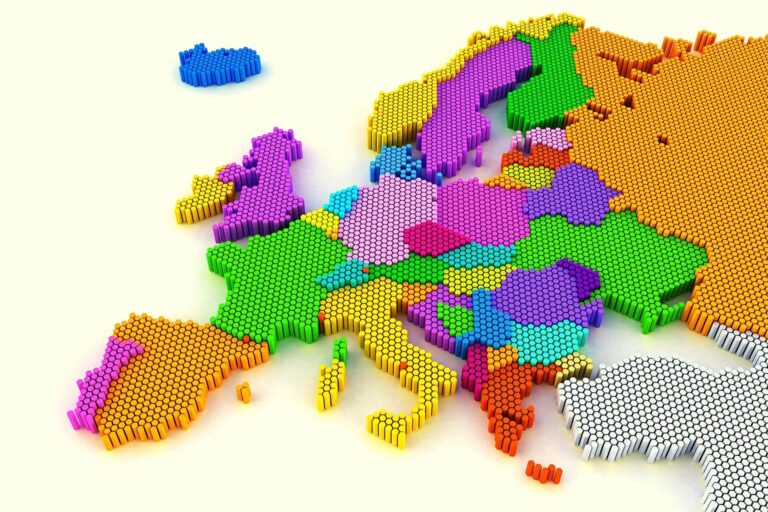
For brands expanding into Europe, what are the hidden gems in the European e-commerce market? Which “non-usual suspects” offer cross-border sellers many opportunities, are growing fast and are increasingly opening up to international sellers? These are the countries worth a closer look and see if they fit into their internationalization strategy. Based on Internet density, e-commerce turnover and population numbers, 6 countries stand out.
Italy, Denmark, Norway, Poland, the Czech Republic and Sweden. These markets meet a number of characteristics that demonstrate strong e-commerce market development. They are countries where consumers already shop a lot online, yet they present several challenges. The countries were selected based on research conducted by Shopping Tomorrow Cross Border E-commerce and Salesupply. As a basis, they looked at Internet penetration, the percentage of people shopping online, population, and relative and absolute growth across all European countries. The challenges are mainly in localization, sales, marketing and logistics, which are all essential aspects for a successful rollout to a new market. What the biggest challenges are and what the best possible solutions for them are is hard to say, but it is clear that every Cross-Border entrepreneur needs a tailor-made solution!
Current figures show the six are not all moving at the same speed. Online sales in Sweden grew 10% in 2025 to SEK 153 billion. Polish online retail sales rose 6.9% to PLN 92.7 billion in the twelve months to January 2026. Czech e-shops grew 6% in 2025 to CZK 206 billion, after flat sales the year before. Italian B2C e-commerce was forecast to pass €62 billion in 2025, up about 6%. Denmark and Norway are mature markets that grew more slowly: 3% and 4% respectively in 2024, according to the European E-commerce Report 2025.
Big e-commerce market on the rise: Italy
With some support from the government and sellers from abroad, Italy could develop into one of Europe’s largest e-commerce markets in the near future. Digitalization is moving fast: 35.2 million Italians were expected to buy online in 2025, 1.5 million more than a year earlier. In addition, Italian consumers are increasingly behaving as cross-border consumers. The increase in popularity of online marketplaces as well as, of course, the large fashion market appeal to the buying behavior of young Italian consumers in particular, who try to live very much in the now.
The often more affluent older Italians are also a large market in their own right. However, it is still difficult to reach them for e-commerce sales, which in many cases is due to a lack of trust in carriers providing delivery. Delivery options such as pickup points help, but coverage is uneven. The biggest challenge in the Italian market, for both Italian and foreign sellers, lies in fast delivery to the less accessible southern part of the country. Logistically, it is up to the Cross-Border seller to determine how to deliver as competitively as possible. This can be done with a local or international warehouse. Consider this carefully and see which local last-mile carrier is a good fit.
To outline the opportunities and challenges a bit more generally, we looked at the previously mentioned four key aspects in Cross-Border e-commerce: localization, sales, marketing and fulfillment.
Localization and sales
Localization is one of the keys to Cross-Border success. To start selling in a new market, consumers must be convinced to prefer a foreign webshop over a domestic one. Consumers around the world prefer to shop and communicate in their own language and with tools that are familiar to them. Therefore, make sure you have a fully localized product offering on your shop, equipped with locally common payment methods (e.g. Vipps in Norway, MobilePay in Denmark and Swish in Sweden, which together were used for 23% of Nordic shoppers’ latest online purchase in early 2026), local delivery options (e.g. service-point delivery in Denmark, where it is the most common method for 51% of online shoppers), local return options and the option to contact the consumer in their language (especially essential in the Czech Republic, Poland and Italy). In addition, it is wise to consider the popular sales channels by country. For example, for Poland and Italy, it is good to know that they are very oriented toward buying on online marketplaces. Get well versed in the preferences by country!
Marketing
For Italian consumers the first impression is extremely important, Norwegian consumers are very brand and product loyal and for Swedish consumers sustainability is very important. These are (product) aspects that can be used to ensure that a consumer stays on your shop, gets convinced to make a purchase and possibly come back to make a purchase at a later stage. Online marketing is the main growth channel in each of these countries. Especially for the younger generations, social media is the main channel for advertising. In Sweden and Norway, influencers are important. Because social media users are increasingly aware of this, for these countries a well thought-out influencer strategy is a good way to build your brand. Despite social media’s dominance, traditional media should not yet be erased. For example, in Norway, newspapers are still common places to advertise and in Italy there is still a huge reach for advertising through television. So look carefully at the fertile places to advertise by country.
Fulfillment
Generally speaking, it can be said that consumers in non-usual suspect countries choose fast delivery. Perhaps more importantly, delivery should preferably be free. Returns are also an important part of a successful logistics rollout. Like delivery, returning purchased products is preferably free, and it is desirable to offer a local return address. As mentioned, especially in Italy, trust in logistics service providers is still low. Each country brings its preferences for the location of delivery and the service involved.
Conclusion
The six non-usual suspect countries, Denmark, Italy, Norway, Poland, Czech Republic and Sweden, are interesting markets for online sellers with cross-border ambitions. Some, like Denmark and Norway, are mature and growing slowly. Others, like Sweden and Poland, are still adding volume at a healthy pace. This offers cross-border sellers many opportunities, but also some challenges. A good strategy in terms of localization, marketing and logistics is the key to success.
However, there is no blueprint for a cross-border rollout to any of the countries. Every entrepreneur is unique and has different challenges. One market may be a better fit than another. It remains important to look at your own situation; what does the competition do in a cross-border destination? How are things logistically arranged there? What kind of marketing strategy will you adopt? With that in mind, as a cross-border seller, you can make an analysis of the market that offers the most potential for you.
Shipping to customers in other countries?
Talk to a fulfillment expert →