Playbook for Selling in Europe
A free 48-page guide for brands outside the EU that want to sell to European consumers. It covers what shoppers expect country by country, which products face stricter rules than in the US, how VAT and IOSS work, which marketplaces, payment methods and carriers matter in each market, and a checklist to run before you launch.
Get your free copy
Fill in the form to get the playbook. No cost, no obligation.
By submitting you agree to Salesupply contacting you. No spam.
Eight Chapters, From First Question to Launch Checklist
- p. 4
Common characteristics
The rules every EU market shares: GDPR, consumer rights, the euro and SEPA, cross-border VAT and the role of marketplaces.
- p. 6
Consumer preferences
How shoppers differ in Scandinavia, Germany and France, the Benelux, the UK, Italy and Spain, Poland and the Czech Republic.
- p. 12
Product regulations
What you can sell in the US but not in Europe: food additives, cosmetic ingredients, chemicals, children's products and energy-inefficient electronics.
- p. 16
Getting started
Goals, market potential, business models from vendor to merchant of record, VAT and IOSS, customs codes, payments and registering your business.
- p. 28
Local marketplaces
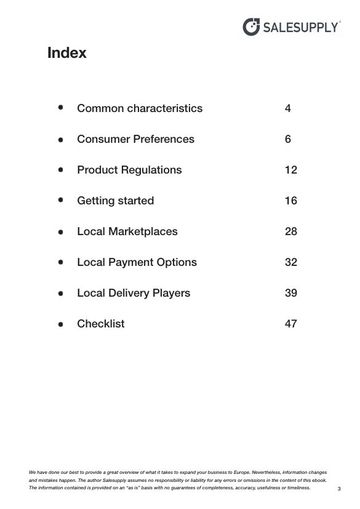
The marketplaces that lead each national market, from Amazon and eBay to bol, Allegro, Zalando and MediaMarkt.
- p. 32
Local payment options
The payment methods consumers expect per country, such as iDEAL, Bancontact, BLIK and Bizum.
- p. 39
Local delivery players
The carriers that deliver in each market and the delivery options consumers count on.
- p. 47
Checklist
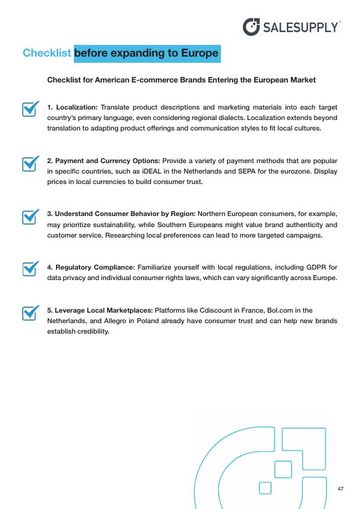
Five checks before you launch: localization, payments and currency, regional consumer behavior, regulatory compliance and local marketplaces.
Three Things the Playbook Tells You
- One VAT registration rarely stays one. The One-Stop Shop lets you report cross-border sales to consumers through a single registration, but storing stock in several EU countries means registering for VAT in each of them.
- Payment habits are local. iDEAL leads in the Netherlands, Bancontact in Belgium and BLIK in Poland. A checkout without them loses buyers.
- Some US products need reformulating. Certain parabens in cosmetics, specific phthalates in children's products and a range of food additives are restricted or banned in the EU.
Written for Brands Entering Europe
First EU market
Brands from the US, the UK and beyond that are choosing where to start in Europe and what that launch requires.
Marketplace sellers
Sellers deciding between Amazon, Zalando, bol, Allegro and the local players that lead each country.
Teams comparing countries
Ecommerce and operations teams weighing consumer habits, payments, regulation and delivery before they commit stock to a market.
From Playbook to First Orders
The playbook tells you what each market expects. Salesupply runs the operation behind it: fulfillment across Europe from local centers, customer service in 25+ languages and local returns in 13 countries, connected to your store through one integration. Brands that ship from outside the EU at first can start with cross-border fulfillment and move stock closer to their customers as volumes grow.
Questions About the Playbook
Plan Your European Launch
48 pages on what each European market expects, from consumer habits to VAT, marketplaces and delivery.