Benelux Post-Purchase Benchmark: How 100 Major Webshops Score in Peak Season

Peak season is the ultimate test in e-commerce: under high pressure, the weak spots in every operation are mercilessly exposed. Order volumes shoot up, carriers run in the red, and customers? They expect the same effortless experience as always: delivery as indicated, including updates, plus easy returns and fast refunds. (Want to see the report right away? Scroll down and save it without leaving your details.)
That is exactly why Returnless, Salesupply and Sendcloud tested the post-purchase journey of 100 of the largest webshops in the Netherlands and Belgium on Black Friday (28 November 2025). A real stress test, in other words. We placed orders at all 100 shops on Black Friday and sent returns back during the December peak. The goal: not just to check whether a parcel arrives, but to examine the entire post-purchase journey. From promise to delivery, from return to refund, from "where is my parcel?" to "is customer service available?"
The result is the report "The Customer Journey During Peak Season: How Did the Largest Webshops in the Benelux Perform?", a benchmark for every e-commerce professional who wants to retain customers and values good reviews.

The good news: many webshops deliver surprisingly well in peak season. But when it comes to communication, returns processes and customer service, there are still many points where the customer experience falls short and shops leave revenue on the table.
Why the post-purchase phase is so important
By the post-purchase experience we mean everything that happens after the purchase: order confirmation, shipping and delivery communication, delivery, unboxing, returning or exchanging, and contact with customer service.
The post-purchase experience is one of the most underestimated parts of the customer journey. For many customers, the time between purchase and delivery is the most emotional part: doubts (will it arrive on time?), expectations (might it come today already?) and a track-&-trace page refreshed just a little too often are standard parts of it.
A strong post-purchase experience gives webshops the following benefits:
- Satisfied, loyal customers who come back and are less likely to drop off after one poorer experience.
- Fewer standard questions for customer service – if customers know where their parcel is, they don't need to send a "Where is my order?" (WISMO) request.
- More revenue – because you use the period after purchase to deepen the relationship instead of solving problems.
With increasing competition from (among others) international marketplaces and aggressive discounters, it is precisely this post-purchase phase that is of crucial importance.
The findings: delivery and the basics in good order
While delivery and the basics are often in good order, it is mostly communication, the returns process and customer service where the frictions lie that directly affect customer experience, costs and conversion.
Below you will find the key insights from the report.
1) Shipping & delivery
On-time delivery: 91% keep their promise
During Black Friday, 91 of the 100 orders arrived within the promised delivery time. For the busiest period of the year, that is surprisingly strong. Delivery speed was also high, with an average delivery time of 1.7 days. This shows once again that next-day is the norm in the Netherlands and Belgium.
Free shipping from…
Consumers paid an average of €4.38 in shipping costs (with 20 webshops always shipping for free). Where there was a free-shipping threshold, it averaged €45.12 (median €50). Webshops therefore use free shipping tactically to push up the AOV. It is important, though, to mention that free-shipping threshold early in the buying process.
The big missed opportunity: choice of carrier
Only 15% of webshops let customers choose their carrier at checkout. So 85% do not yet do so. And that is exactly the kind of detail customers do care about: preferences for a particular carrier, parcel-shop options, delivery days, or simply bad experiences from the past. In short: no choice of carrier has an impact on your conversion.
2) Returns: paid is the new standard
Returns are the least loved part of e-commerce — and one of the most expensive. Yet it is also a service moment that can build trust. Provided you set up the process, including communication, properly.
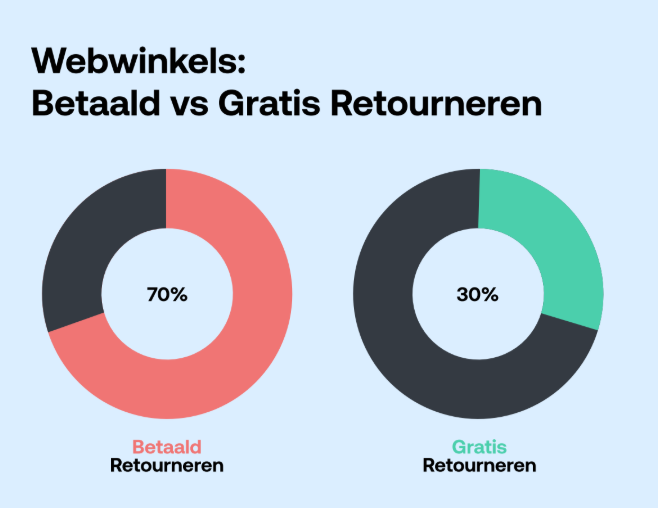
Free returns are disappearing: 70% charge a fee
70% of the webshops surveyed charged for returns, 30% still offer it for free. That is a clear trend: returns eat up profitability, so retailers are focusing on cost control. Understandable. But it only works if you are transparent before the purchase. Otherwise it feels like a penalty after the fact.
Returns portal: the majority (55%) has one, but almost half still don't
Returns are not yet seen by all retailers as a process to be optimised: 55% of webshops use a digital returns portal. 45% do not yet. That is striking, because a portal is not just "handy", it offers:
- self-service for the customer
- less pressure on customer service
- overview for operations
- Insights to fix structural issues (sizing, quality, expectations).
Return labels divide the market
47% of the shops surveyed provide a return label, 6% even put the label in the box already, and 47% leave it to the customer to arrange the label themselves. That last category is tricky: "arrange it yourself" costs the customer extra effort, and often more money too. That is exactly the kind of friction that leads to "I'll never order here again".
Refunds: 36% leave the customer in uncertainty
This is perhaps the most painful finding: 36% communicate insufficiently during the refund process. No updates, no clear expectation, no "return received" or "refund started". The customer is left completely in the dark, and that while the average refund period in this study was 8 days.
This uncertainty about money not only means extra frustration for the customer but also guaranteed extra work for customer service, and that during peak season.
A refund seems to be the only option, but is it?
88% of the webshops surveyed offered only a refund, just 6% offer an exchange and 4% offer store credit/a coupon to limit the loss of revenue. And that while around 55% of the shops surveyed work with a returns platform that makes these options easy to offer.
3) Customer service: unavailable when people shop?
Customer service is an indispensable part of the post-purchase experience: it is the safety net when something goes wrong with shipping, returns and/or refunds. In those cases, customer service is the last chance to save the customer relationship. But before the purchase too, the availability of customer service is very important to answer any questions and remove doubts.
To be able to offer real service, it is important to have your customer service available when the consumer is actually shopping. During this study, that turned out to be only partly the case.
Only 28% of the shops visited offer customer service in the evening hours
During office hours, the customer service of virtually every shop surveyed (92%) is reachable, although a number of them only for part of that time.
It gets more painful when we look at availability during the evening hours, a popular shopping moment in e-commerce: only 28% of the webshops surveyed were reachable for customers in the evening.
And that grates. Because the evening is an important online shopping moment. If you are unreachable then, you not only lose service quality — you lose conversions too.
- 92% are reachable during office hours
- only 28% on weekday evenings
- 30% on Saturday during the day
- 5% available the entire weekend
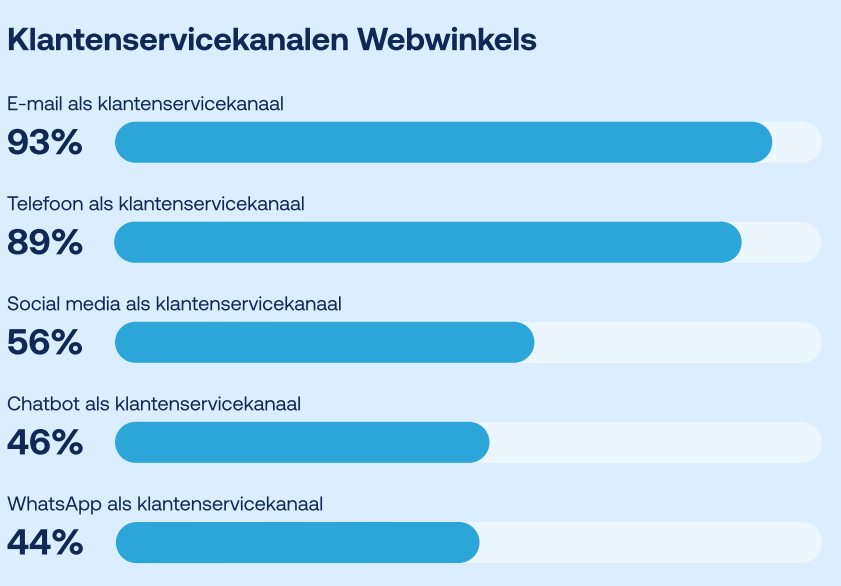
Customer service reachable via 3 channels on average
The shops surveyed offer an average of 3.25 customer service channels. This way the consumer can choose the channel that appeals to him or her most. Virtually every shop (93%) offers email as a customer service channel, followed by phone (89%) and social media (56%). So not every shop offers phone as a channel, even though this is mandatory within the EU.
Striking: in daily life, WhatsApp is one of the most used communication channels for consumers. Yet only 44% of retailers offer it as a contact option. While WhatsApp actually makes it easier for the consumer to get in touch. Also in view of the limited opening hours of customer service, automation via WhatsApp offers webshops opportunities.
AI in customer service: still only used to a limited extent
AI is the topic of conversation everywhere, but in practice 69% of the webshops surveyed had not yet implemented an AI solution for customer service (such as an AI chatbot) within the webshop.
"Handling FAQs, relieving the customer service team, cost reduction, 24/7 customer service on the site: AI can add a lot of value within e-commerce customer service," says Hans Siebum. "Especially when you look at the limited availability of customer service in the evenings and at weekends. That is where a large share of the webshops we looked at are really leaving revenue on the table. AI could serve well there as first aid to remove pressing questions and doubts that are still costing the shops revenue today."
Important: AI doesn't have to be able to do everything right away. Start smart: FAQs, WISMO, returns policy/process and payment options. Define the scope and let your team work together with the bot.
Immediately applicable: 9 practical quick wins
Don't feel like going through the report and want to get started right away? Understandable. Here are 9 quick wins that will immediately make a difference in your post-purchase process:
- Show delivery time visibly on the product page + checkout
- Show shipping costs early (and be clear about the free-shipping threshold)
- Offer more delivery choice (parcel shop, pick-up, carrier choice where possible)
- Make registering a return self-service (a returns portal, or at least one clear flow)
- Communicate return costs before purchase (product page/checkout)
- Send proactive refund updates (return received + refund started)
- Make exchange/credit an option (without pushing, but presented smartly)
- Align opening hours with shopping moments (even if it is 'light' in the evening)
- Use WhatsApp/AI chat to reduce pressure and help outside opening hours
Curious about further results and tips from the study? Click download and the report opens directly (no contact details required).

Want to benchmark your own post-purchase journey?
Talk to Our Team →